

What is GEO? Differences from SEO and Why You Should Start Now
We explain what GEO (Generative Engine Optimization—how to organize content to be referenced by AI) means, how it differs from SEO, and which businesses need it most.
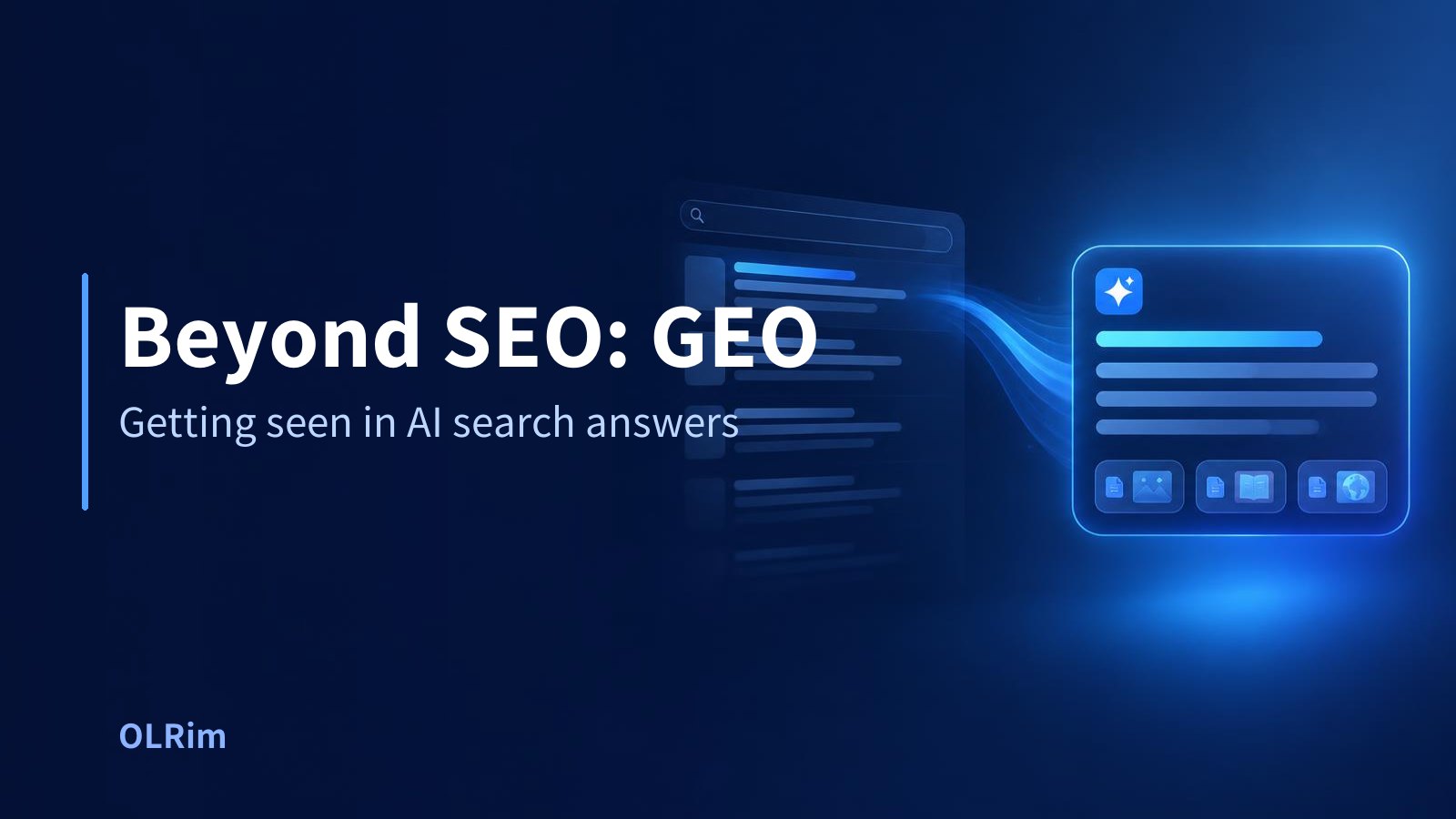
One-line answer: GEO (Generative Engine Optimization) is the process of organizing your content and website so that AI tools like ChatGPT, Gemini, and Perplexity accurately mention your brand and cite your website as a source when generating answers. While SEO focuses on "where you appear in search result lists," GEO focuses on "whether you are included in the answer the AI writes for the user."
The way people search is changing
In the past, when people were curious about something, they would type a few words into a search bar and click through a few of the 10 blue links provided. Today, many people ask AI questions in full sentences and receive a summarized answer that the AI has compiled after reading multiple webpages.
For example, if you ask, "Tell me which pediatricians in Gangseo-gu are open on weekends," the AI refers to various sites and provides a curated list. At this point, the user might make a decision without clicking a single link. This phenomenon is called Zero-Click Search (a search that ends without a website visit).
What this change means is simple: even if you are ranked #1 in search results, if your name is missing from the AI's answer, the customer may never know you exist. Conversely, even if your ranking is slightly lower, you can be introduced in the answer if the AI deems you a reliable source.
SEO vs. GEO: What is the difference?
| Category | SEO (Search Engine Optimization) | GEO (Generative Engine Optimization) |
|---|---|---|
| Goal | Top exposure in search result lists | Mentions and citations within AI answers |
| User Behavior | Clicks links to read directly | Reads the answer summarized by AI |
| Query Type | Short keywords ("Gangseo-gu pediatrician") | Long sentences/dialogue ("Are any open on weekends?") |
| Evaluation Unit | Entire page | Paragraphs or sentences within a page |
| Key Signals | Keywords, links, speed | Clear answers, factual info, sources, consistency |
| Performance Metrics | Rankings, click-through rate | Mention status, citation status, accuracy |
| Result Stability | Relatively consistent | Answers can change even for the same question |
The biggest difference is the evaluation unit. Instead of looking at a long piece of writing as a whole, AI picks specific paragraphs that match the question. Therefore, "content where meaning is clear even if you only read one paragraph" is advantageous for GEO.
Should I abandon SEO and only do GEO?
No. The two are not in competition; they have a foundation and application relationship.
Many AI search services search the web to gather data before creating an answer. This method is called RAG (Retrieval-Augmented Generation). During the data-finding stage, the technical standards of search engines still apply.
- If search robots cannot read your page, AI cannot read it either.
- If a page is too slow, it may be excluded during the data collection phase.
- If the same content is scattered across multiple addresses, the AI gets confused about which one is the primary source.
In short, think of it this way: you use SEO to create a "site that can be read" and GEO to create "content that the AI wants to cite."
What kind of content does AI want to cite?
AI's internal criteria are not fully public. However, based on public documentation and actual response trends, the following types of writing tend to be cited more easily:
- Direct answers to questions: State the conclusion in the first paragraph.
- Factual writing: Includes verifiable information like prices, business hours, and service scope.
- Content with clear authorship: Displays the author, company information, and last modified date.
- Structured content: Content is divided by subheadings, lists, and tables.
- Consistent brand messaging across platforms: Company info matches across the website, map services, and blogs.
Conversely, writing that only repeats keywords, uses exaggerated numbers without sources, or contains fabricated reviews actually decreases trust.
Which industries is this particularly important for?
- Professional Services (Hospitals, Law, Tax, Consulting): Customers often ask AI for judgments like "Which place is trustworthy?"
- Local Businesses (Restaurants, Academies, Salons): There are many conditional questions like "nearby," "weekends," or "parking available."
- B2B, Manufacturing, Software: An increasing number of decision-makers ask AI for comparison tables or implementation methods first.
- Online Shopping: It is important whether a product is mentioned in "recommendation" or "comparison" queries.
Regardless of the industry, the impact of GEO is greater in fields where customers ask many questions before making a decision.
Why you should start now
- AI tends to repeatedly use sources it already knows. Places that build trust early are more likely to be mentioned continuously.
- Incorrect information can spread. If a closed branch or an old price remains in an AI answer, customers will be confused. Clearly stating the latest information on your official site is the best prevention.
- The cost of preparation is not high. For most, you can start by organizing site information and improving your writing style.
3 things to do when starting out
- Input 5 questions a customer might ask into ChatGPT or Gemini and record whether your brand appears.
- Check if your company name, address, contact information, and service details are visible at a glance on your homepage.
- Pick 5 frequently asked questions from customers and write them on your site in a Q&A format.
Frequently Asked Questions
Q. Does doing GEO guarantee I will appear in AI answers?
No. AI answers vary by question, timing, and user. GEO is about increasing the "possibility of appearing" and ensuring you "appear accurately when you do," but it does not guarantee exposure.
Q. Does advertising help me appear in AI answers?
General AI answers are generated independently of ad purchases. Even if some services operate separate ad areas, being cited in the main body of the answer depends on the reliability of the content.
Q. How quickly do results appear?
Each AI service has a different cycle for reflecting web information, and these are often not public. Therefore, it is realistic to check the same questions repeatedly over weeks or months to observe changes.
Q. Can small companies do this too?
Yes. In fact, small companies with clear information and narrow areas of expertise are sometimes cited better for specific questions. We provide step-by-step guidance in our [GEO Implementation Checklist for Small Businesses](/blog/small-business-geo-checklist).
Summary
- SEO is about making yourself "found," while GEO is about making yourself "cited."
- The two must go together, and the technical foundation of SEO is the starting point for GEO.
- Clear answers, verifiable facts, and consistent company information are key.
If you are curious about how your site looks to AI right now, check your current status with a free diagnosis from OLRim.